Face Anonymization and GDPR: What Engineers Need to Know
GDPR classifies facial images as biometric data. This post covers the technical and legal requirements for face anonymization in data pipelines.
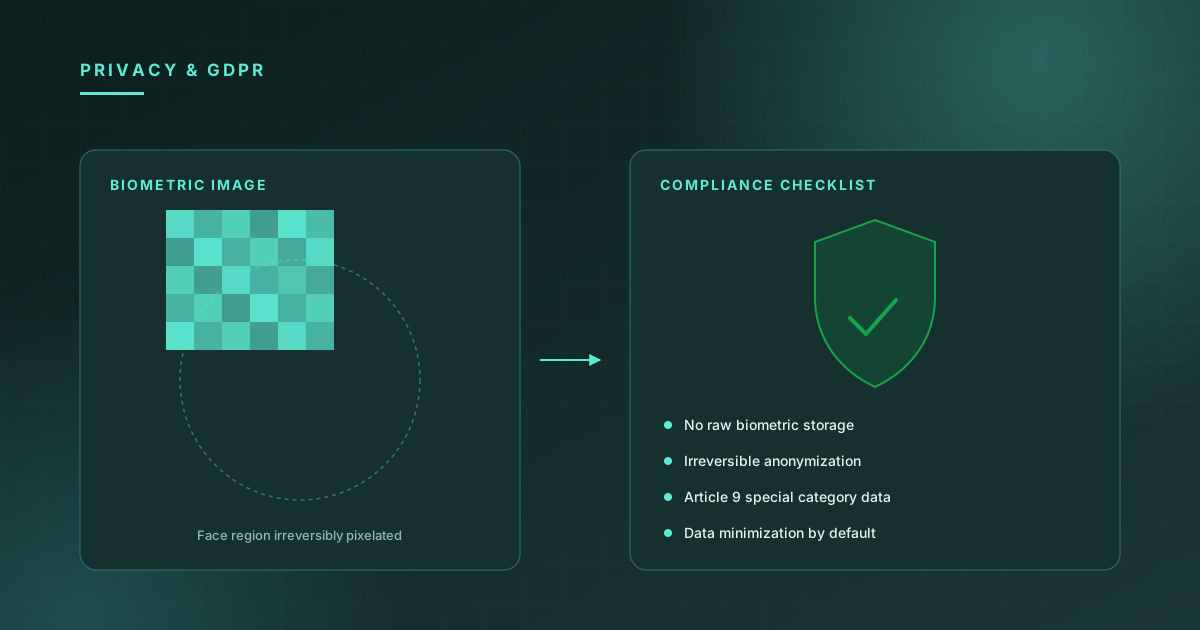
The GDPR's classification of facial images as biometric data (Article 9) caught many engineering teams off guard when the regulation came into force in 2018. Six years later, enforcement actions involving facial data have accelerated — and the technical requirements are clearer than ever.
What GDPR says about facial images
Facial images are biometric data when they are "processed through a specific technical means allowing the unique identification or authentication" of a person. The key phrase is "through a specific technical means."
A JPEG of a crowded street scene, in isolation, is not automatically special category data. The same image stored in a system that runs face recognition on it and links results to individual profiles is.
For most data processing purposes in fintech, healthcare, and gig-economy platforms, the safe assumption is that any image that could plausibly identify an individual requires special category treatment: explicit legal basis, data minimization, and appropriate technical measures.
The data minimization principle
Data minimization (Article 5(1)(c)) requires that personal data be "adequate, relevant and limited to what is necessary in relation to the purposes for which they are processed."
For many use cases — training datasets, public-facing video, user-generated content — the facial data itself is not necessary. The downstream task doesn't require identifiable faces. This is where anonymization becomes not just a compliance option but a requirement.
Anonymization vs. pseudonymization. GDPR makes an important distinction. Pseudonymized data (faces replaced with IDs or hashes) is still personal data — the original face can be linked back given additional information. Truly anonymized data (faces blurred or replaced with synthetic faces) falls outside GDPR's scope entirely, provided re-identification is not reasonably possible.
Technical requirements for effective anonymization
Not all blur is equal. A 2-pixel Gaussian blur that degrades visual quality but doesn't prevent recognition by a face recognition system is not anonymization — it's obfuscation. Regulators have taken enforcement action against companies that applied minimal visual treatments while claiming GDPR compliance.
Effective anonymization for facial data requires:
-
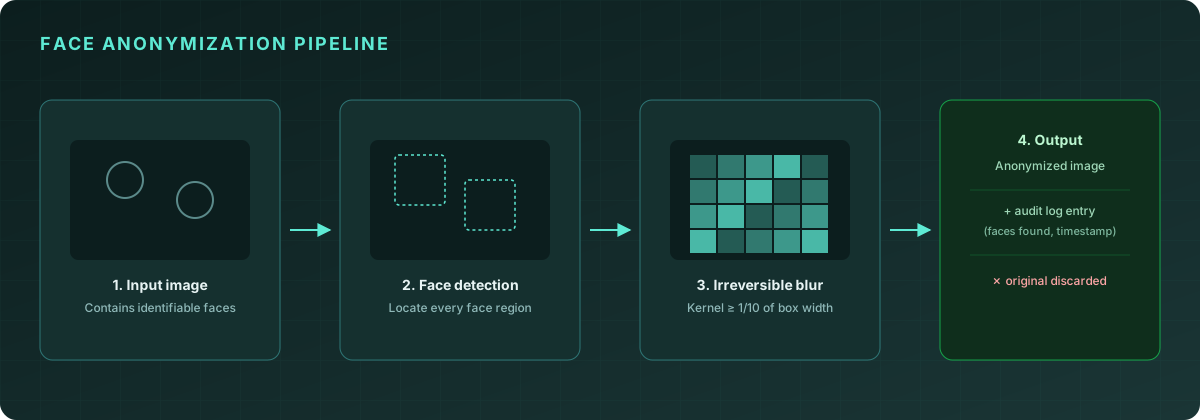
Detection before transformation. You need reliable face detection to ensure every face in an image is processed. A missed face in a training dataset undermines the anonymization guarantee.
-
Sufficient transformation strength. The transformed image should not be reversible to the original with reasonable effort. For blur-based approaches, this typically means applying Gaussian blur with a kernel size of at least 1/10th of the bounding box width.
-
No separate storage of originals. The anonymized image should replace the original, not supplement it. Storing both defeats the purpose.
-
Batch processing audit logs. For large-scale anonymization pipelines, maintain logs of what was processed, when, and the result (faces detected, faces anonymized). This supports accountability obligations under Article 5(2).
Building a compliant anonymization pipeline
A minimal compliant pipeline for an image dataset detects every face, applies an irreversible transformation, logs the result for audit purposes, and discards the original:
import { Quantilence } from "@quantilence/sdk";

const client = new Quantilence({ apiKey: process.env.QUANTILENCE_API_KEY });

async function anonymizeImage(imagePath: string): Promise<Buffer> {
  const image = await fs.readFile(imagePath);

  const result = await client.faceBlur.process({
    image,
    blurStrength: 15,  // Sufficient for anonymization
    returnBoundingBoxes: true,
  });

  // Log for audit trail
  await auditLog.record({
    imagePath,
    facesDetected: result.facesDetected,
    processedAt: new Date(),
    anonymized: true,
  });

  return result.processedImage;
}
Checklist before shipping
- [ ] Legal basis documented for any remaining facial image processing
- [ ] Data minimization analysis completed — do you need identifiable faces?
- [ ] Face detection coverage validated on a representative sample
- [ ] Blur strength tested against a face recognition system
- [ ] Original images not retained after anonymization
- [ ] Audit log implemented and retained per your data retention policy
- [ ] DPA (Data Processing Agreement) in place with your face processing vendor
The Quantilence Face Blur API is GDPR-ready by design: we don't store images beyond the request, process on EU infrastructure by default, and provide audit-ready request logs. Learn more →